 EDII
Until now, AGU only answered inside EDII's own products. From today anyone can call it: a student building a study app, a team that wants a model it can pay for in rupees, or the person at a school who looks after its computers and wants to put together a small tool.
In one line
Point any OpenAI SDK at https://api.ask.edii.in/v1, use the model agu-v2 and an API key from developer.edii.in (opens in new tab). The first 10,000 tokens are free; after that, ₹100 buys 10,000 more.
What AGU is
AGU is EDII's language model. The version open to developers, agu-v2, is a 4-billion-parameter instruction model that runs on our servers in Bengaluru, and it is the same model that serves EDII's own school features. It is good at explanations, summaries, rewriting and short answers: the work a study helper, a notes tool or a feedback writer needs.
It is a small model, so it can be wrong. Check any fact that matters before you show it to someone.
Three steps to your first reply
- Sign in with Gmail. Continue with your Google account, so there is no new password to remember. Gmail accounts only for now. New accounts start with 10,000 free tokens.
- Create an API key. Name it after the app that will use it. You see the full key once, so put it straight into your app's secrets. An account can hold up to five keys.
- Send a request. Use any OpenAI SDK with the base URL
https://api.ask.edii.in/v1and the modelagu-v2, or call it with curl.
There is no form to fill and no sales call. It takes about two minutes.
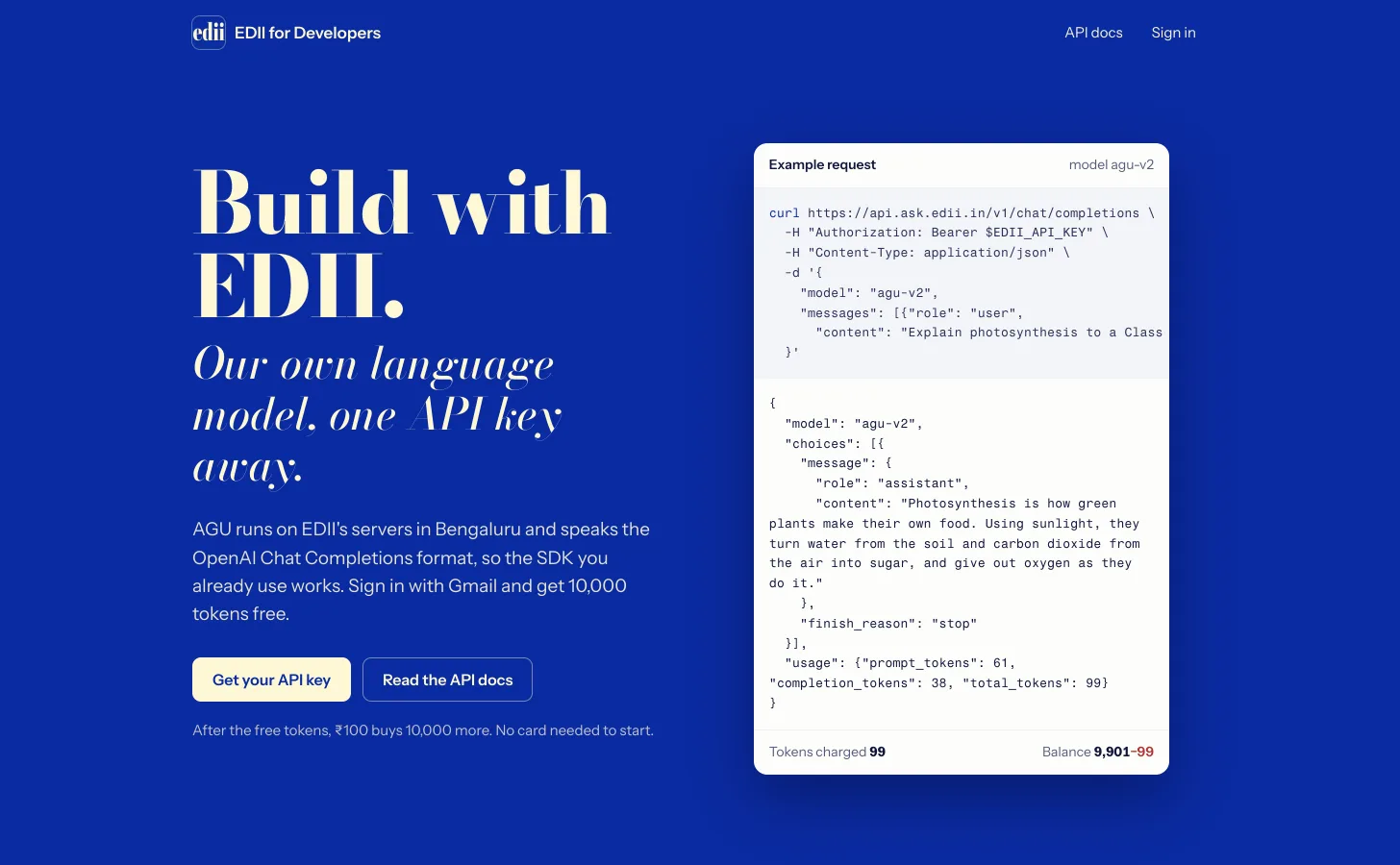
Your first call
Set EDII_API_KEY to the key from your dashboard. With curl:
curl https://api.ask.edii.in/v1/chat/completions \
  -H "Authorization: Bearer $EDII_API_KEY" \
  -H "Content-Type: application/json" \
  -d '{
    "model": "agu-v2",
    "messages": [
      {"role": "system", "content": "You are a friendly science tutor."},
      {"role": "user", "content": "Why is the sky blue?"}
    ],
    "max_tokens": 200
  }'
Or with the OpenAI Python SDK. Only the base URL and the model change:
# pip install openai
import os
from openai import OpenAI

client = OpenAI(
    base_url="https://api.ask.edii.in/v1",
    api_key=os.environ["EDII_API_KEY"],
)

reply = client.chat.completions.create(
    model="agu-v2",
    messages=[
        {"role": "system", "content": "You are a friendly science tutor."},
        {"role": "user", "content": "Why is the sky blue?"},
    ],
    max_tokens=200,
)
print(reply.choices[0].message.content)
print("tokens charged:", reply.usage.total_tokens)
The Node.js SDK works the same way: set baseURL and apiKey and keep the rest of your code. Every reply carries the tokens charged in usage, and your remaining balance comes back in the X-EDII-Balance-Tokens header. GET /v1/balance returns it on its own.
What it costs
A request uses the tokens in your prompt plus the tokens AGU writes back. Your balance only goes down when the model answers.
| What | Price |
|---|---|
| Your first 10,000 tokens | Free |
| Every 10,000 tokens after that | ₹100 |
| Monthly fee | None |
| Requests that fail or time out | Not charged |
You buy tokens in packs of 10,000 from the dashboard and pay in rupees through Razorpay. No card is needed to start. A short question with a paragraph-long answer is usually 150 to 300 tokens, so 10,000 tokens covers roughly 40 to 60 of them.
Good to know before you build
- Limits. 20 requests a minute per account, up to 2,048 tokens per reply (512 if you don't set
max_tokens), and 20,000 characters of conversation. - Busy moments. AGU also answers for EDII's schools, so at a busy moment you may wait a few seconds or be asked to try again.
- Streaming is accepted, but the reply arrives in one piece.
- Counting. Reply tokens are counted exactly and prompt tokens are estimated. Every response shows what was charged.
- Not supported yet: images, audio, tools and function calling, embeddings, and more than one reply per request.
The docs
The full reference is at developer.edii.in/docs (opens in new tab): every endpoint, request and error, and you can try calls from the page. The OpenAPI file is at api.ask.edii.in/developer/openapi.json (opens in new tab), ready for Postman or a code generator.
Run by EDII, the school operating system
EDII runs admissions, fees, attendance, exams and parent messages for 150+ schools. AGU is the model behind EDII's own features; with EDII for Developers, you call the same model with your own key.
Get your API key
Sign in with Gmail and the first 10,000 tokens are on us.